

How to Set Up & Tune Your Guzheng · 古筝怎么装码和调音
For safe shipping, the bridges are packed separately and the strings are loosened. Setting up your guzheng takes a little patience, but it is not difficult. Just follow the steps below.
Quick Tuning Guide – Zhuque Class, with English subtitles. The video uses a clip-on tuner; a tuner app works the same way.
What you need
- The tuning wrench and the bridges (both included)
- The bridge placement diagram (included with your guzheng)
- A tuner: the free app Guzheng – Virtual Zither for All, which has a built-in tuner (iPhone · Android). A clip-on tuner works just as well: set it to key of D, 440 Hz, as shown in the video.
Know your strings
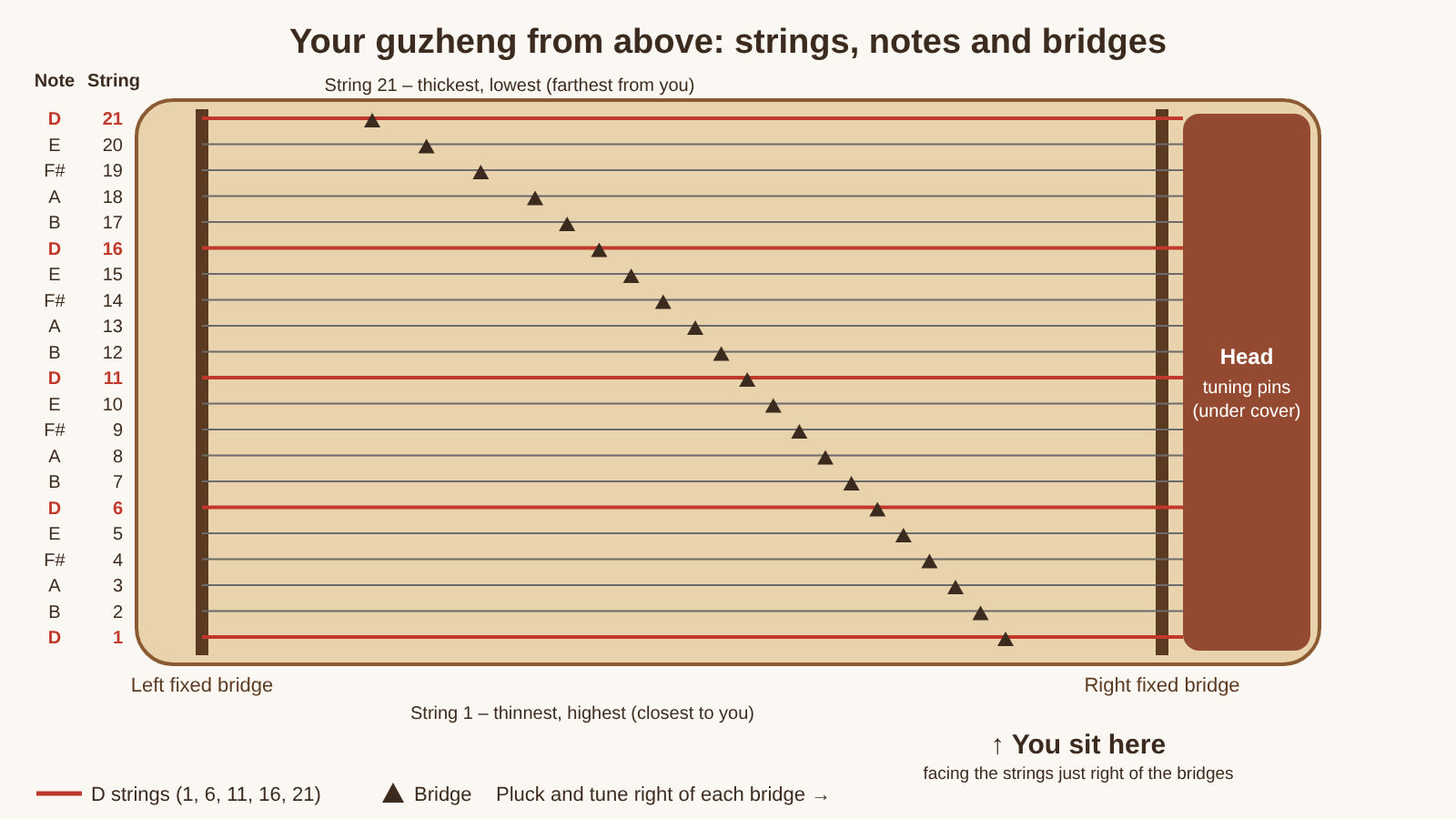
Your guzheng has 21 strings, tuned to a D major pentatonic scale: D – E – F# – A – B, repeating.
- String 1 is closest to you: the thinnest and highest.
- String 21 is farthest from you: the thickest and lowest.
- The D strings are 1, 6, 11, 16 and 21.
From string 21 up to string 1, the notes are:
D E F# A B · D E F# A B · D E F# A B · D E F# A B · D
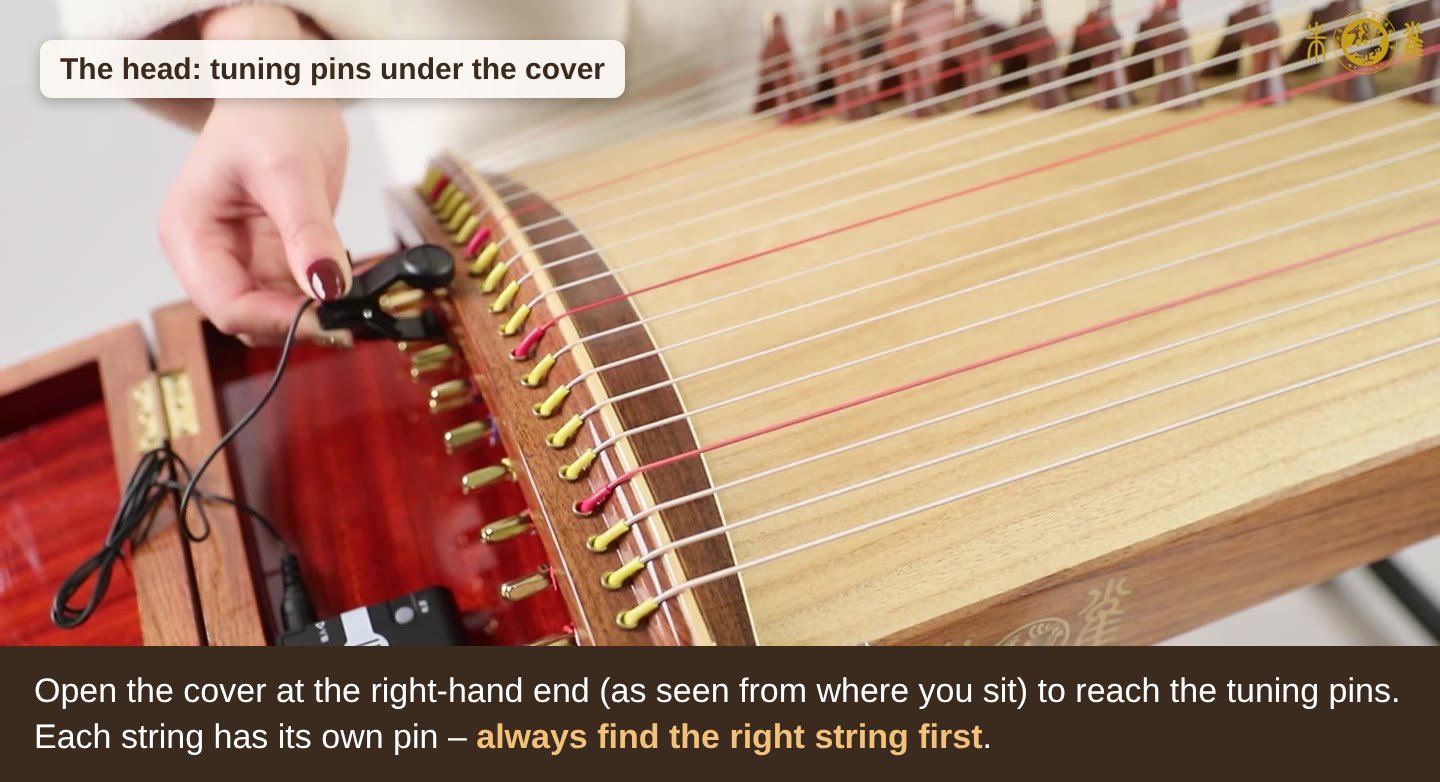
The tuning pins are at the right-hand end of the instrument (the head). Always pluck the part of the string to the right of its bridge.
Step 1 – Place the bridges
- The strings should be neither too loose nor too tight: just enough tension that a bridge stays in place without falling over.
- The bridges are numbered: bridge 1 goes under string 1, bridge 2 under string 2, and so on. Seat each string in the groove on top of its bridge.
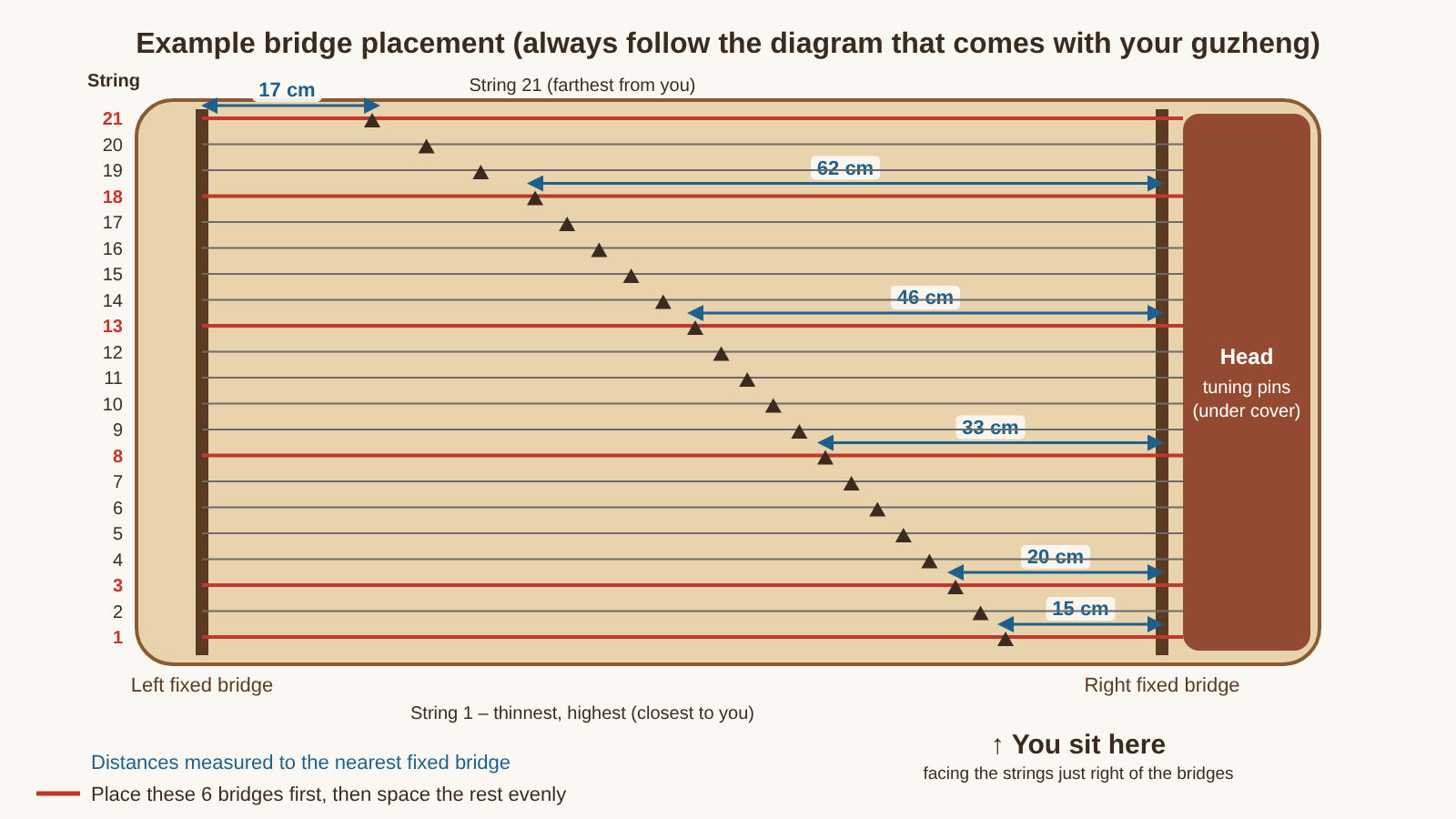
- Follow the bridge placement diagram that came with your guzheng, because each brand's measurements differ slightly. As an example, a typical diagram looks like this:
- String 1: 15 cm from the right-hand fixed bridge
- String 3: 20 cm · String 8: 33 cm · String 13: 46 cm · String 18: 62 cm
- String 21: 17 cm from the left-hand fixed bridge
- Each bridge should stand upright with both feet flat on the soundboard. Looking along each string, the bridge should line up with the string's contact points at the left and right ends, giving 21 straight, parallel lines.
Step 2 – First tuning, in two rounds
- Round 1: Tune the strings one by one, a little below pitch. Bringing a string up to pitch in one go is not recommended. As the tension rises, use less force and smaller turns, especially on the thinner strings 1–6.
- Relax the strings: Gently press each string on both sides of its bridge. Straighten any bridge that has moved, and make sure its feet sit flat on the soundboard.
- Round 2: Now carefully bring every string to its correct pitch. Press both sides of each bridge again and recheck.
How to tune one string
- Find the right string first. Count from string 1, the one closest to you. Then find the tuning pin that belongs to that same string, so you always turn the right one.
- Select the same string number in the tuner app. For example, to tune string 8, choose string 8 in the app, so the tuner knows which note to expect.
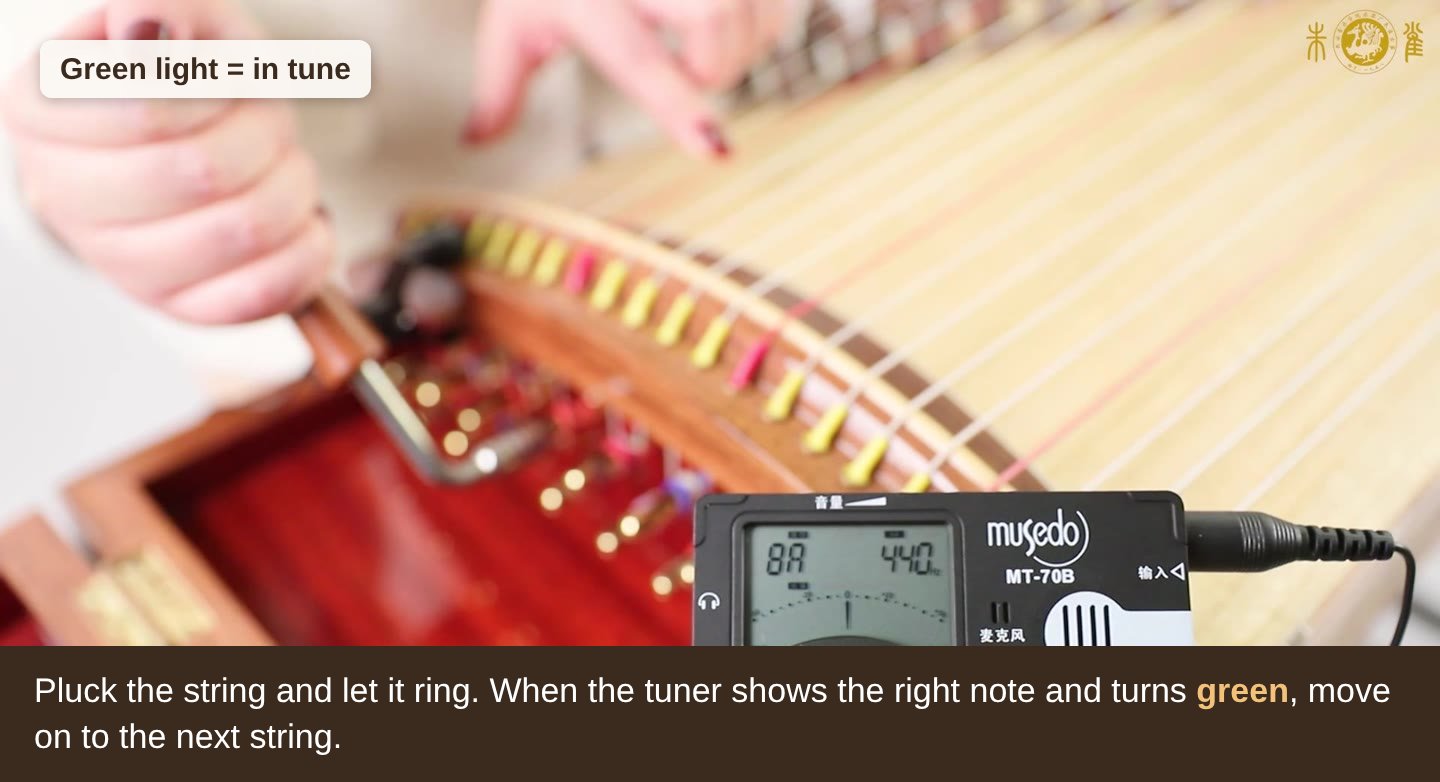
- Tune in a quiet room and hold your phone close to the strings. Pluck the string to the right of its bridge and let it ring.
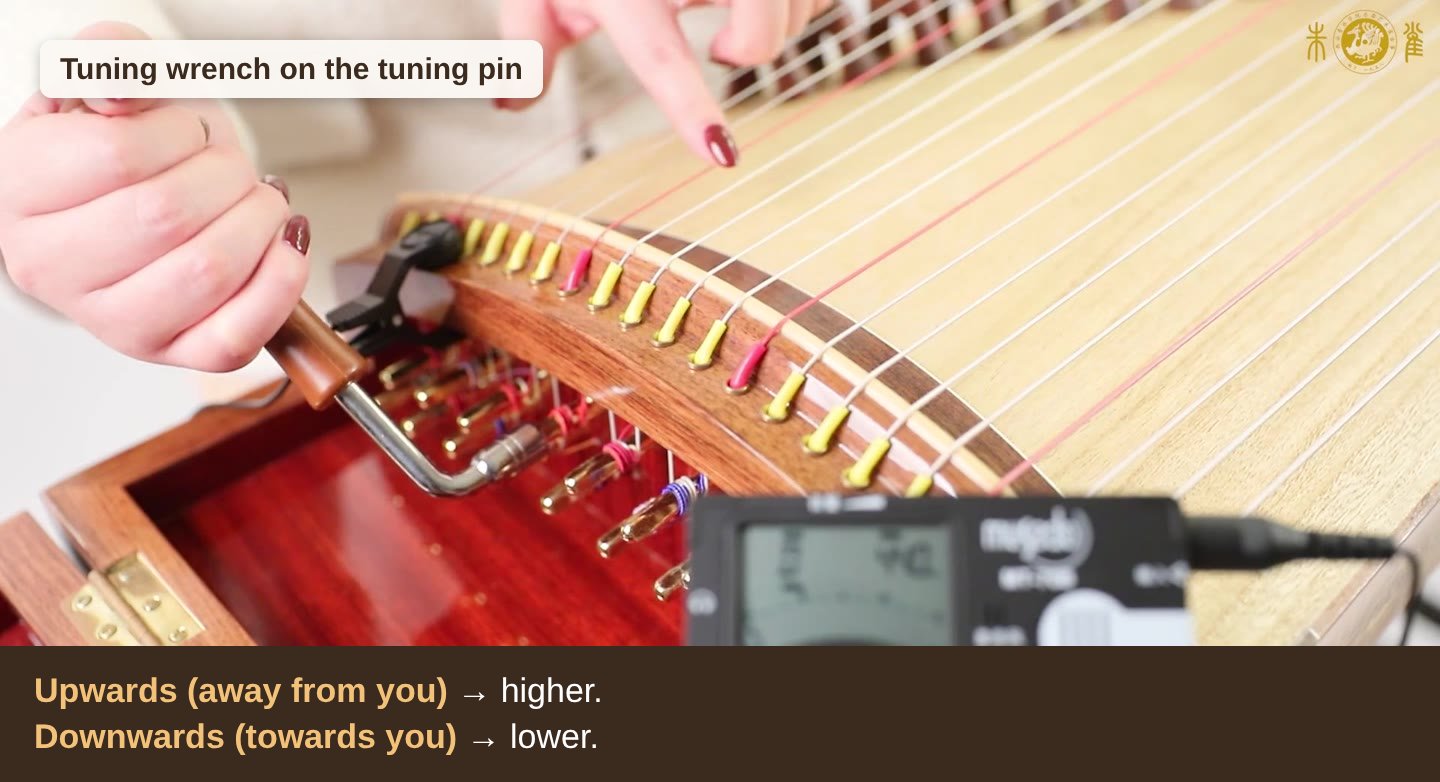
- Low: gently turn the wrench upwards, away from you, in small steps.
- High: turn the wrench downwards, towards you, until the string is slightly below the note. Then turn it gently upwards again until it is in tune.
- Green light: the string is in tune. Move on to the next string.
- Almost there: for a very small correction, slide the bridge 1–2 mm. To the right raises the pitch, to the left lowers it.
The first weeks
A new guzheng needs time to settle. Tune it a little every day. At first, play slow pieces and plenty of slides, and pluck each string in different directions. Save fast, vigorous pieces for later, once the tuning holds.
Caring for your guzheng
- Keep it at 20–26 °C and 40–60 % humidity.
- Avoid direct sunlight, radiators and other heat sources, and avoid using a wet cloth.
- When you are not playing, cover it with a large cloth. This keeps dust off and helps the tuning stay stable.
Questions? Simply contact us – we are happy to help.
More guides: Guzheng Buying Guide · Guzheng Care in Winter · Browse our guzheng
古筝怎么装码和调音
为了运输安全,古筝的码子是单独包装的,琴弦也是松开的。安装和调音需要一点耐心,但并不难,按下面的步骤来就可以。
上面的视频是朱雀课堂的《快速调音指南》,带英文字幕。视频里用的是夹式调音器,用手机调音 App 方法一样。
需要准备
- 调音扳手和筝码(随琴附带)
- 筝码示意图(随琴附带)
- 调音器:免费 App「Guzheng – Virtual Zither for All」,自带调音器(iPhone · 安卓)。也可以用夹式调音器,设置为 D 调、440 Hz,和视频里一样。
认识琴弦
古筝有 21 根弦,按 D 调五声音阶定弦:D – E – F# – A – B 循环。
- 1 弦离你最近,最细,音最高。
- 21 弦离你最远,最粗,音最低。
- D 音在 1、6、11、16、21 弦。
从 21 弦到 1 弦,音依次是:
D E F# A B · D E F# A B · D E F# A B · D E F# A B · D
弦轴在琴的右端(琴头)。调音时拨的是码子右边的那段弦。
第一步:放码子
- 琴弦不要太松也不要太紧,码子放上去不会倒就可以。
- 码子有编号:1 号码放在 1 弦下,2 号码放在 2 弦下,依此类推。琴弦要落在码子顶部的槽里。
- 请按琴附带的筝码示意图摆放,各品牌的尺寸略有不同。常见的示意图大致如下:
- 1 弦:距右岳山 15 厘米
- 3 弦 20 厘米 · 8 弦 33 厘米 · 13 弦 46 厘米 · 18 弦 62 厘米
- 21 弦:距左岳山 17 厘米
- 每个码子都要立正,两只码脚贴平面板。顺着每根弦看,码子和琴弦左右两端的接触点应在一条线上,21 根弦形成 21 条平行的直线。
第二步:第一次调音,分两遍
- 第一遍:一根一根调,先调得比标准音略低一点。不建议一次就调到位。弦越来越紧时,用力要小、转动幅度要小,1–6 弦比较细,尤其要小心。
- 放松琴弦:在每个码子左右两边轻轻按一按琴弦。把移动了的码子扶正,确认码脚贴平面板。
- 第二遍:再仔细把每根弦调到标准音。左右再按一按,再检查一遍码子。
单根弦怎么调
- 先找对弦。从离你最近的 1 弦数起,再找到这根弦对应的弦轴,确保拧的是同一根。
- 在调音 App 里选同一个弦号。比如调 8 弦,就在 App 里选 8 号弦,调音器才知道目标音是什么。
- 在安静的房间里调,手机靠近琴弦。在码子右边拨弦,让它响着。
- 音低:扳手向上(往外推)轻轻转,一点一点来。
- 音高:扳手向下(往里拉)转,调到比标准音略低一点,再轻轻往上调到准。
- 绿灯亮:这根弦调准了,换下一根。
- 差一点点:可以把码子挪动 1–2 毫米微调,往右音高,往左音低。
新琴头几周
新琴需要时间稳定,每天都调一调。开始时多弹慢曲子、多弹滑音,每根弦从不同方向都弹一弹。快速激烈的曲子等音准稳定以后再弹。
日常保养
- 温度保持在 20–26 °C,湿度 40–60%。
- 避免阳光直射、暖气和其他热源,避免用湿布擦。
- 不弹的时候用一块大布盖上,既防尘,也能让音准更稳定。