
How to Set Up & Tune Your Guzheng
For safe shipping, the bridges are packed separately and the strings are loosened. Setting up your guzheng takes a little patience, but it is not difficult. Just follow the steps below.
Quick Tuning Guide – Zhuque Class, with English subtitles. The video uses a clip-on tuner; a tuner app works the same way.
What you need
- The tuning wrench and the bridges (both included)
- The bridge placement diagram (included with your guzheng)
- A tuner: the free app Guzheng – Virtual Zither for All, which has a built-in tuner (iPhone · Android). A clip-on tuner works just as well: set it to key of D, 440 Hz, as shown in the video.
Know your strings
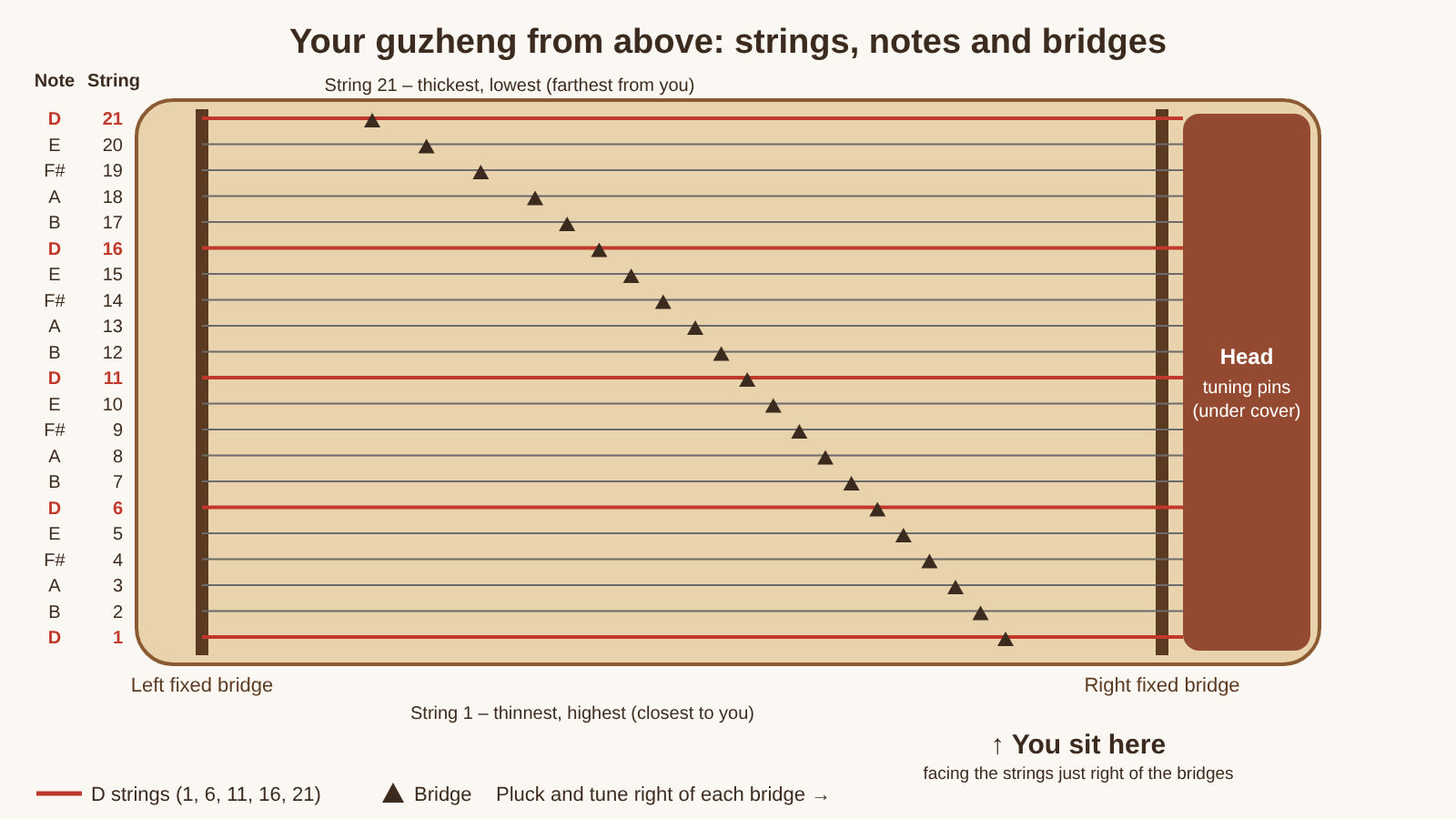
Your guzheng has 21 strings, tuned to a D major pentatonic scale: D – E – F# – A – B, repeating.
- String 1 is closest to you: the thinnest and highest.
- String 21 is farthest from you: the thickest and lowest.
- The D strings are 1, 6, 11, 16 and 21.
From string 21 up to string 1, the notes are:
D E F# A B · D E F# A B · D E F# A B · D E F# A B · D
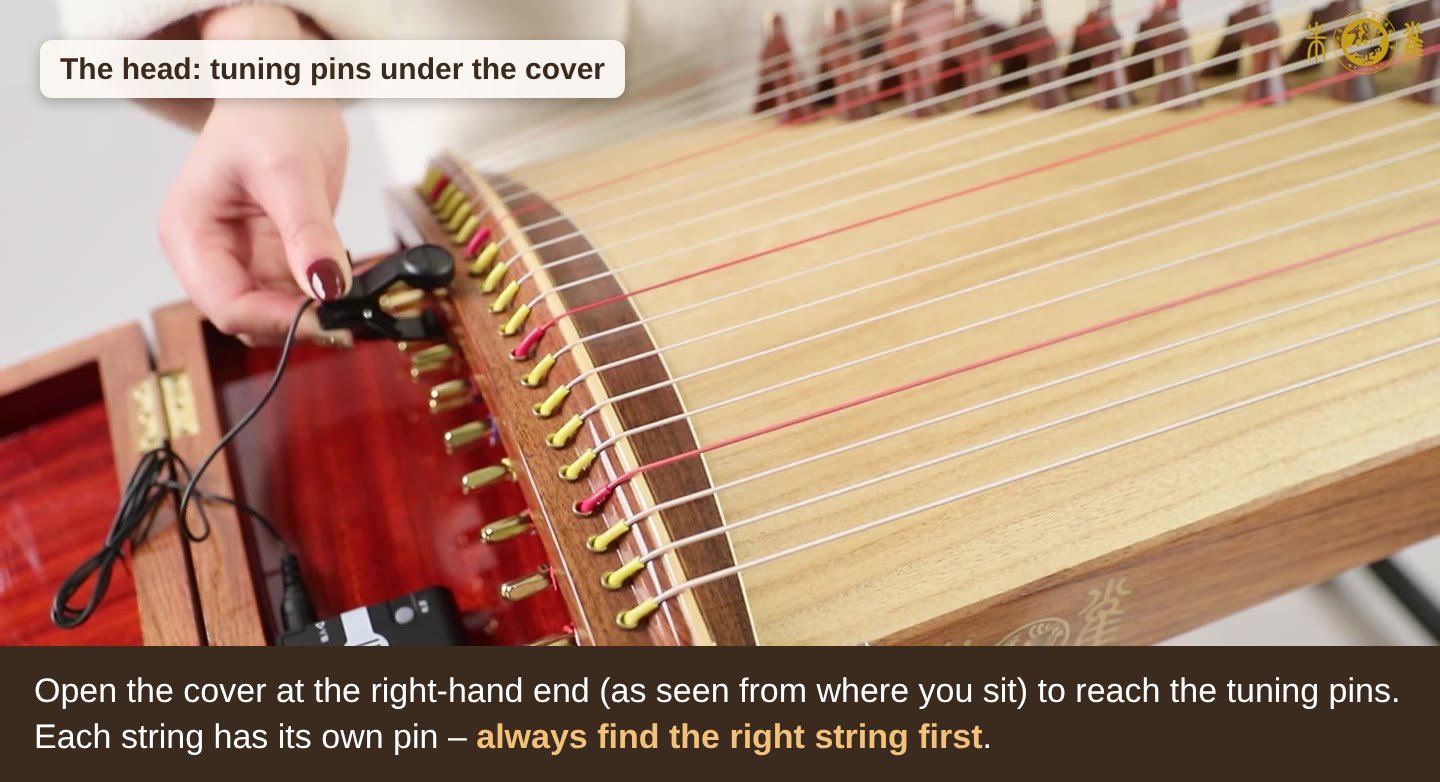
The tuning pins are at the right-hand end of the instrument (the head). Always pluck the part of the string to the right of its bridge.
Step 1 – Place the bridges
- The strings should be neither too loose nor too tight: just enough tension that a bridge stays in place without falling over.
- The bridges are numbered: bridge 1 goes under string 1, bridge 2 under string 2, and so on. Seat each string in the groove on top of its bridge.
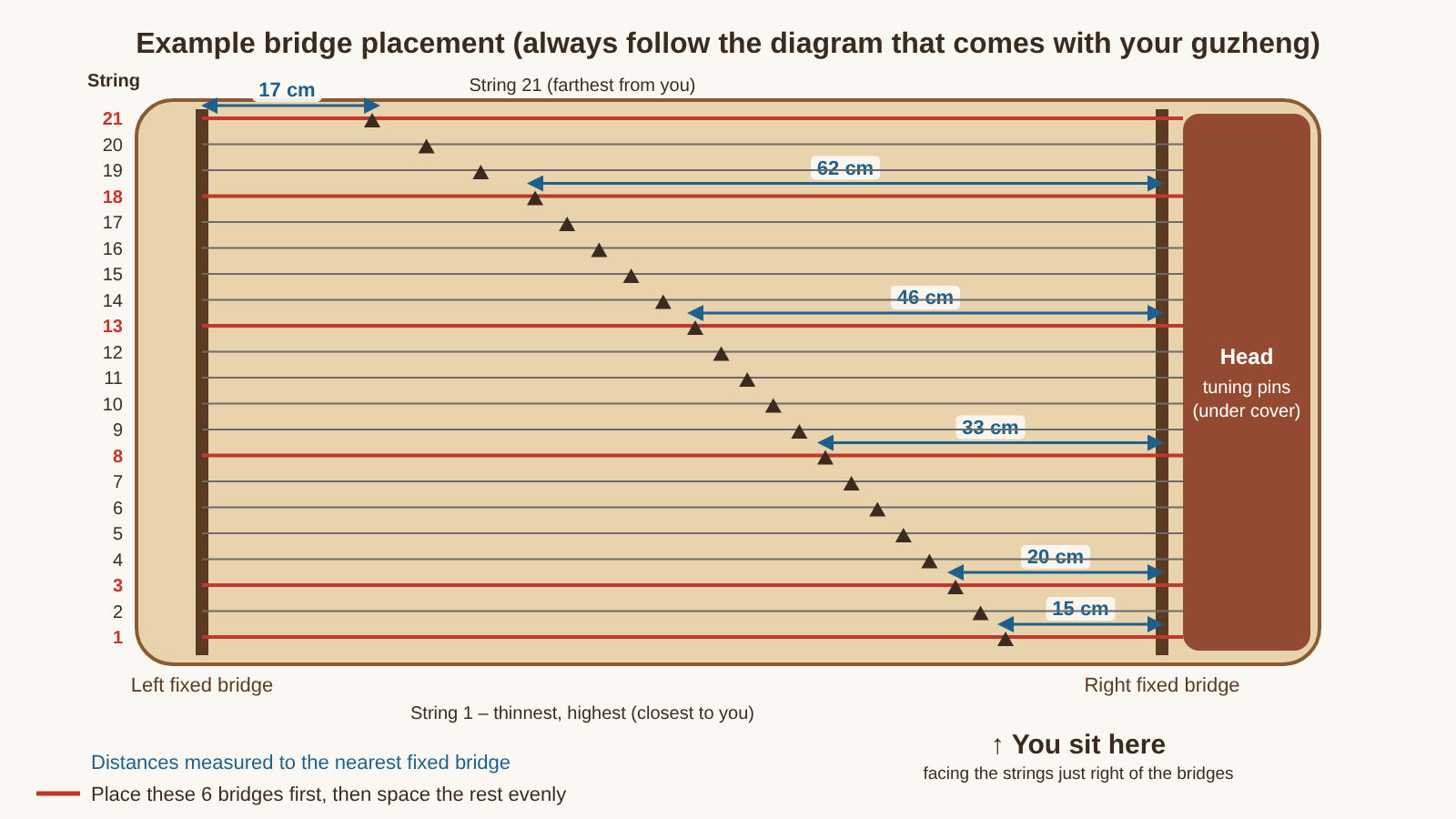
- Follow the bridge placement diagram that came with your guzheng, because each brand's measurements differ slightly. As an example, a typical diagram looks like this:
- String 1: 15 cm from the right-hand fixed bridge
- String 3: 20 cm · String 8: 33 cm · String 13: 46 cm · String 18: 62 cm
- String 21: 17 cm from the left-hand fixed bridge
- Each bridge should stand upright with both feet flat on the soundboard. Looking along each string, the bridge should line up with the string's contact points at the left and right ends, giving 21 straight, parallel lines.
Step 2 – First tuning, in two rounds
- Round 1: Tune the strings one by one, a little below pitch. Bringing a string up to pitch in one go is not recommended. As the tension rises, use less force and smaller turns, especially on the thinner strings 1–6.
- Relax the strings: Gently press each string on both sides of its bridge. Straighten any bridge that has moved, and make sure its feet sit flat on the soundboard.
- Round 2: Now carefully bring every string to its correct pitch. Press both sides of each bridge again and recheck.
How to tune one string
- Find the right string first. Count from string 1, the one closest to you. Then find the tuning pin that belongs to that same string, so you always turn the right one.
- Select the same string number in the tuner app. For example, to tune string 8, choose string 8 in the app, so the tuner knows which note to expect.
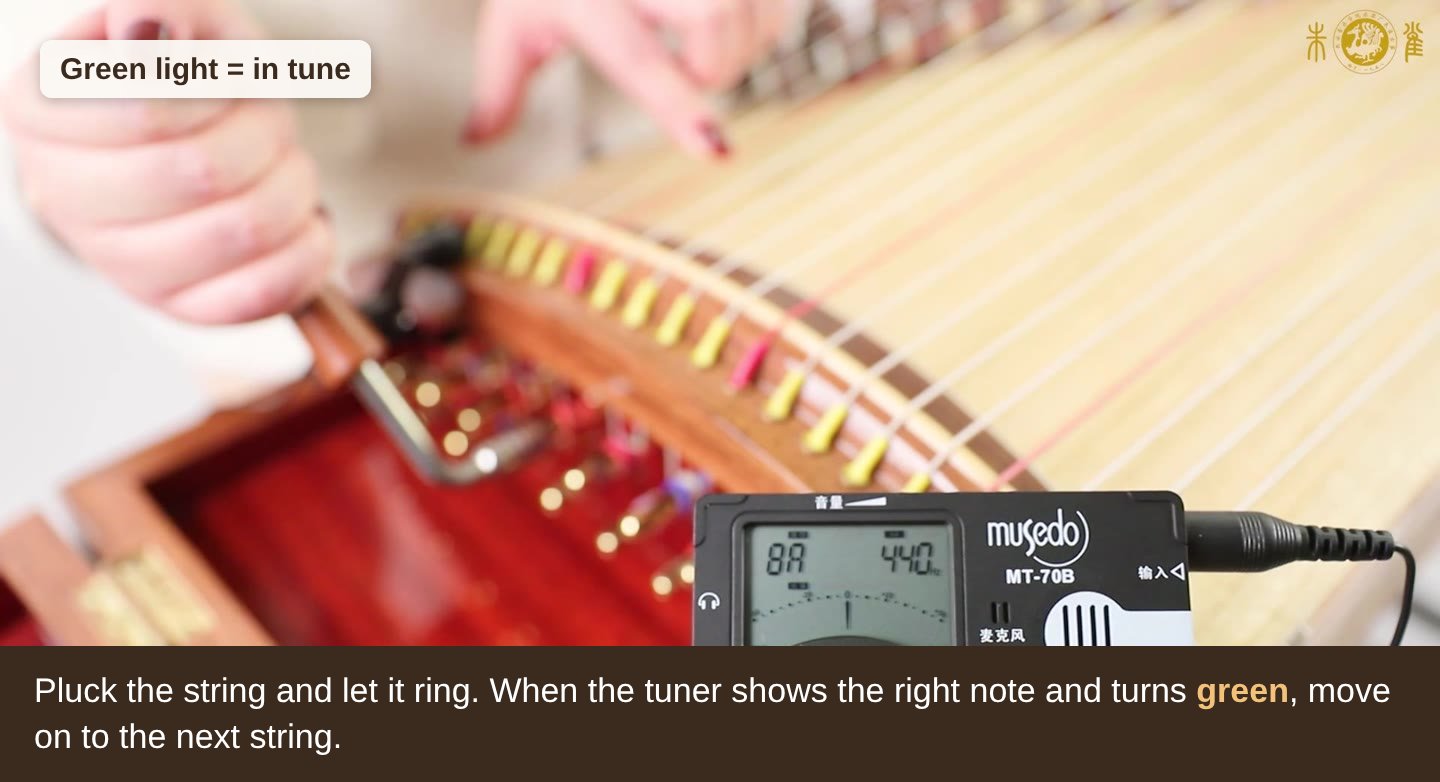
- Tune in a quiet room and hold your phone close to the strings. Pluck the string to the right of its bridge and let it ring.
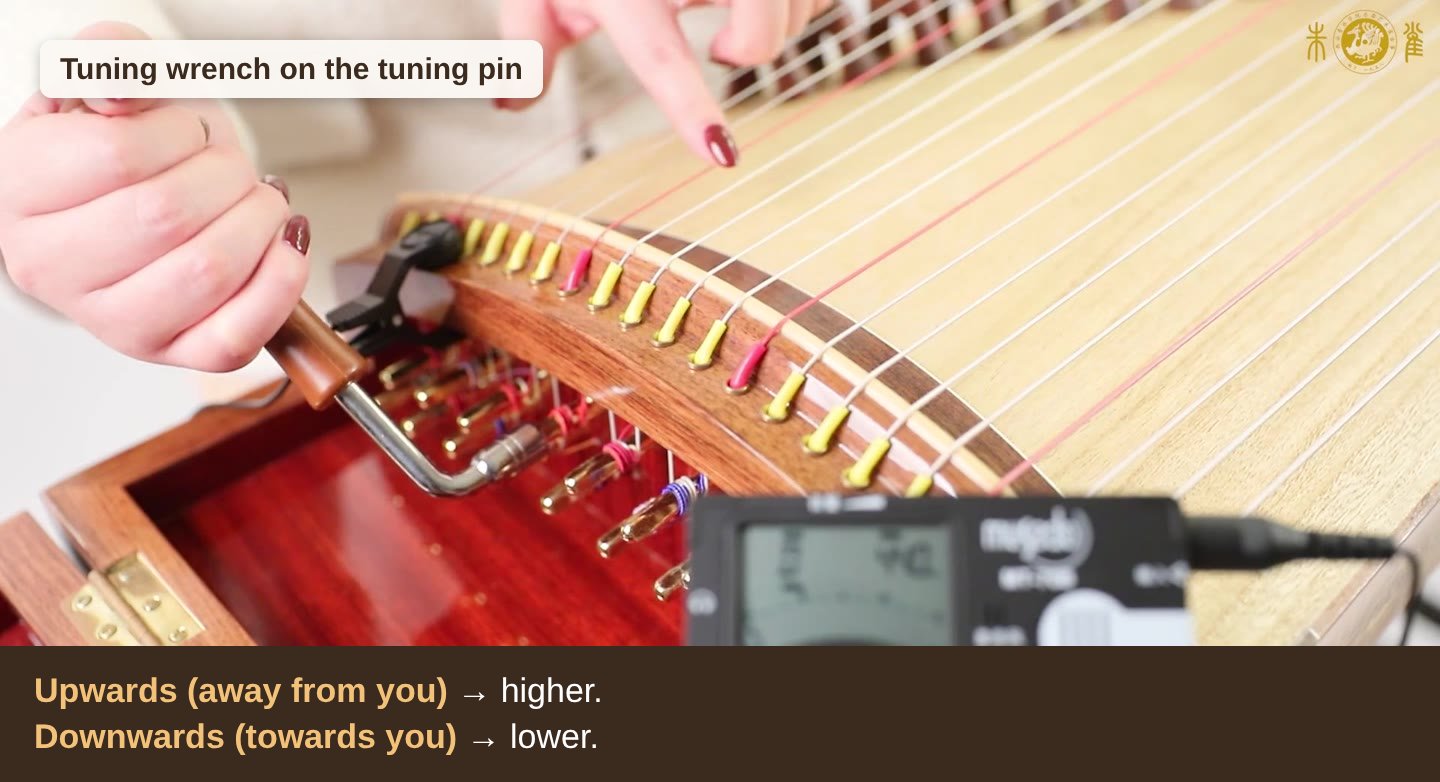
- Low: gently turn the wrench upwards, away from you, in small steps.
- High: turn the wrench downwards, towards you, until the string is slightly below the note. Then turn it gently upwards again until it is in tune.
- Green light: the string is in tune. Move on to the next string.
- Almost there: for a very small correction, slide the bridge 1–2 mm. To the right raises the pitch, to the left lowers it.
The first weeks
A new guzheng needs time to settle. Tune it a little every day. At first, play slow pieces and plenty of slides, and pluck each string in different directions. Save fast, vigorous pieces for later, once the tuning holds.
Caring for your guzheng
- Keep it at 20–26 °C and 40–60 % humidity.
- Avoid direct sunlight, radiators and other heat sources, and avoid using a wet cloth.
- When you are not playing, cover it with a large cloth. This keeps dust off and helps the tuning stay stable.
Questions? Simply contact us – we are happy to help.